How to Write an Internship Resume
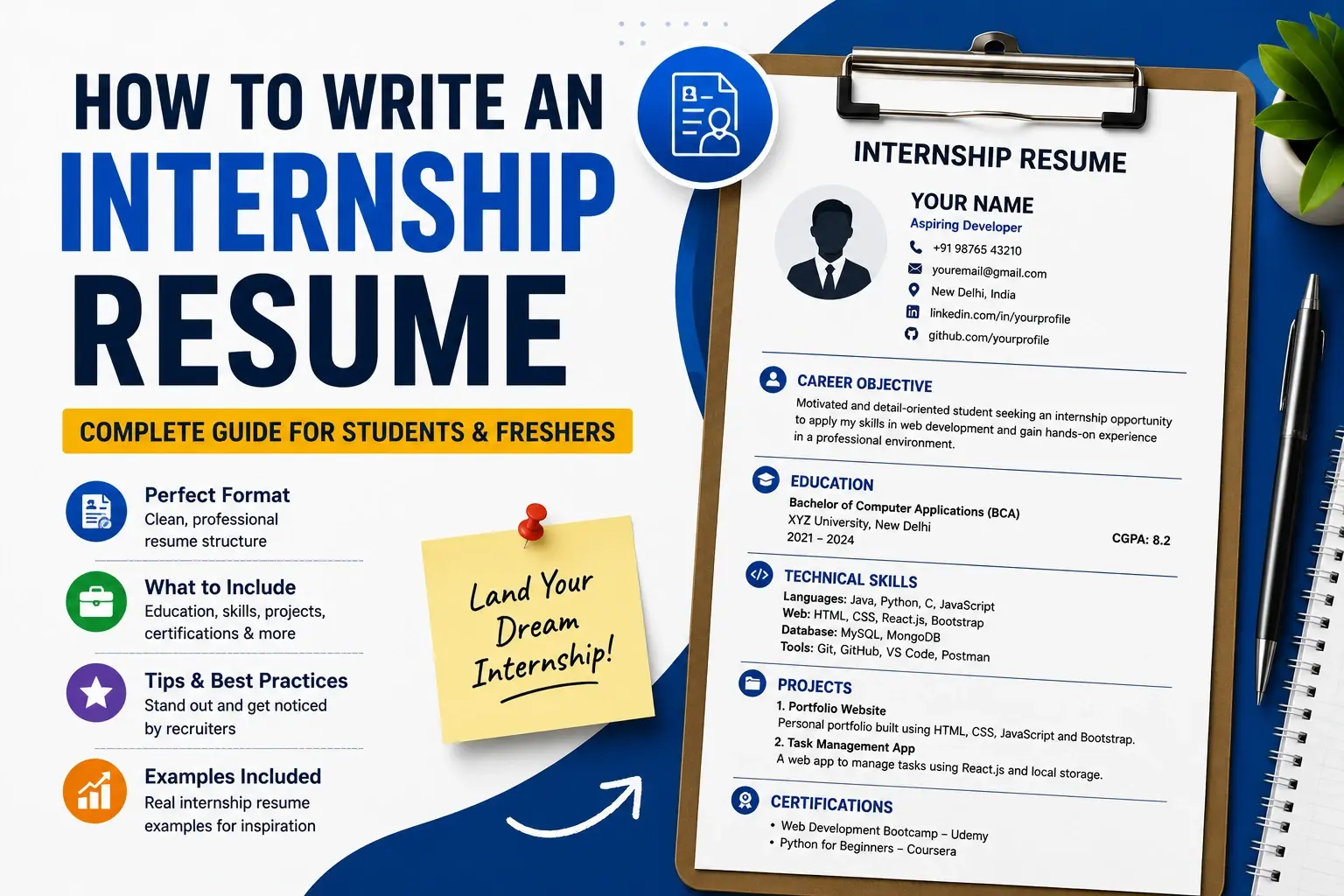
How to Write an Internship Resume: Complete Guide for Students and Freshers
Getting your first internship can be one of the most important steps toward building a professional career. An internship gives students an opportunity to gain practical experience, understand how companies work, and turn classroom knowledge into real-world skills.
But before you get that opportunity, there is one important document you usually need to prepare: your internship resume.
For students and freshers, writing an internship resume can feel difficult because you may not have previous employment experience. You might wonder:
What should I put on my resume if I have never worked?
The answer is simple: your resume doesn't have to depend entirely on work experience.
Your education, academic projects, technical skills, certifications, coursework, hackathons, volunteer work, coding profiles, and personal projects can demonstrate your potential.
In this guide, you'll learn how to write an internship resume from scratch, what sections to include, how to create a resume with no experience, how to describe projects, which skills to mention, how to make an ATS-friendly internship resume, and how to make your application more relevant to the internship you're targeting.
What Is an Internship Resume?
An internship resume is a professional document designed to present a student's or recent graduate's qualifications for an internship opportunity.
Unlike an experienced professional resume, an internship resume usually focuses more heavily on:
Education
Academic projects
Technical skills
Coursework
Certifications
Internships or training
Extracurricular activities
Achievements
Relevant personal projects
The objective is to show the employer that although you may not have extensive professional experience, you already possess relevant knowledge, initiative, and the ability to learn and contribute.
Can You Create an Internship Resume Without Experience?
Absolutely.
This is one of the biggest concerns students have.
An internship is often the opportunity through which you gain your first professional experience, so employers cannot reasonably expect every applicant to have years of employment history.
Instead, use other forms of evidence.
For example:
Education
Your degree and relevant coursework demonstrate academic preparation.
Projects
Your projects show that you can apply what you've learned.
Certifications
Relevant certifications demonstrate focused learning.
Technical Skills
Your skills show what tools and technologies you can work with.
Hackathons
Hackathons can demonstrate teamwork and problem-solving.
Personal Projects
Personal projects demonstrate initiative beyond classroom assignments.
The key is to replace missing employment history with meaningful evidence of ability.
How to Write an Internship Resume Step by Step
A strong internship resume can follow this structure:
Name and contact information
Professional headline
Resume summary or objective
Education
Technical skills
Projects
Internship or training experience
Certifications
Achievements
Relevant profiles
You don't need to include every section if it doesn't add value.
1. Start With Your Name and Contact Information
Place your name prominently at the top.
Below it, include:
Phone number
Professional email
LinkedIn profile
GitHub profile
Portfolio website, if relevant
Example
YOUR NAME
Computer Science Student | Software Development Intern
Phone | Email | LinkedIn | GitHub
Avoid unnecessary personal information such as:
Father's name
Mother's name
Full residential address
Religion
Marital status
Passport details
Unless specifically required by an employer, these details usually don't belong on a modern internship resume.
2. Add a Relevant Professional Headline
A short headline can immediately communicate what type of internship you want.
Examples:
Computer Science Student | Software Development
MCA Student | Full Stack Development
B.Tech CSE Student | Java & Python
Computer Applications Student | Web Development
Data Analytics Student | Python & SQL
Your headline should be truthful.
Don't call yourself a "Senior Software Engineer" when you're applying for your first internship.
3. Write a Short Internship Resume Summary
A summary gives the recruiter a quick overview of your profile.
For students, it can include:
Degree
Technical skills
Project experience
Target internship
Example
MCA student with hands-on experience in Java, Python, SQL, and web development through academic and personal projects. Strong foundation in programming and database concepts with an interest in gaining practical experience through a software development internship.
This is more useful than:
Hardworking student looking for an opportunity to learn and grow.
Be specific about what you know.
4. Education Can Be Your Strength
If you're a student without work experience, education deserves a visible position on your resume.
Include:
Degree
University / College
Expected Graduation Year
CGPA or Percentage, when useful
Example
Master of Computer Applications (MCA)
Lovely Professional University
2024 – 2026
Bachelor of Science
XYZ University
2021 – 2024
You can also mention relevant coursework when it supports the internship.
For a software internship:
Data Structures
Database Management Systems
Object-Oriented Programming
Operating Systems
Computer Networks
Web Development
Don't list every subject from your entire degree.
Choose coursework relevant to the position.
5. Create a Strong Technical Skills Section
For technical internships, your skills section can quickly communicate your capabilities.
Organize skills into categories.
Example
Programming: Java, Python, C++
Web: HTML, CSS, JavaScript, React.js
Database: MySQL, MongoDB, SQL
Core Concepts: OOP, DSA, DBMS
Tools: Git, GitHub, VS Code, Postman
This is much easier to scan than:
Java Python C++ HTML CSS JavaScript React MySQL MongoDB Git GitHub...
Only mention technologies that you can explain during an interview.
6. Projects Are Extremely Important for Internship Resumes
If you don't have professional experience, your projects become one of your strongest forms of evidence.
A project shows that you have moved beyond theory and actually implemented something.
A good project entry should explain:
What you built
What problem it solves
Technologies used
Important functionality
Your contribution
Example
Expense Tracker Web Application
Technologies: React.js, Node.js, MongoDB
Developed a web application for recording and organizing personal expenses.
Implemented transaction categorization and database-based record management.
Built reusable frontend components and connected the application with backend APIs.
This is much stronger than:
Expense Tracker — React project.
7. Choose Projects Related to the Internship
Your projects should support the type of internship you're applying for.
Software Development Internship
Good projects might involve:
Java
Python
C++
APIs
Databases
Authentication
CRUD operations
Web Development Internship
Consider:
HTML
CSS
JavaScript
React
Node.js
Responsive design
REST APIs
Data Analytics Internship
Useful projects can involve:
Python
SQL
Excel
Pandas
Data visualization
Data cleaning
Machine Learning Internship
Relevant projects can demonstrate:
Python
Pandas
NumPy
Scikit-learn
Data preprocessing
Model evaluation
The project doesn't need to be enormous.
It needs to be relevant and explainable.
8. Describe Your Personal Projects Professionally
Personal projects absolutely count as useful resume content.
You don't need to label them as "just a college project."
Instead, describe what you actually built.
Weak
Made a weather app using JavaScript.
Better
Developed a responsive weather application using JavaScript and a public weather API, allowing users to search locations and view current weather information.
The second version demonstrates:
Development
API integration
User interaction
Practical implementation
9. Mention Your Academic Projects
College projects can be valuable when presented properly.
Instead of:
Major Project: Student Management System
write:
Student Management System
Developed a database-driven application for managing student records.
Implemented record creation, updates, search functionality, and data management.
Used Java and MySQL to build application functionality and database operations.
This tells the recruiter what you actually did.
10. Add Relevant Certifications
Certifications can strengthen an internship application when they support your target role.
Examples include:
Java Programming
Python
SQL
Web Development
Data Analytics
Cloud Fundamentals
Machine Learning
Cybersecurity
Software Testing
Don't fill your resume with every certificate you've ever completed.
A few relevant certifications are more useful than a long collection of unrelated courses.
11. Include Hackathons and Coding Events
Students often underestimate the value of hackathons.
A hackathon can demonstrate:
Problem-solving
Teamwork
Rapid development
Creativity
Technical implementation
Communication
Example
Hackathon Participant
Collaborated with a student development team to build a working prototype addressing a real-world problem within a limited development timeframe.
If you won or achieved a specific position, mention it.
12. Add GitHub to Your Internship Resume
For software-related internships, GitHub can provide additional evidence of your skills.
Before adding the link, make sure your profile is presentable.
Your repositories should ideally contain:
Meaningful project names
README files
Setup instructions
Technologies used
Organized code
Screenshots where useful
A recruiter should be able to open a project and understand what it does.
Don't add GitHub merely because everyone else does.
Add it when it supports your application.
13. Use LinkedIn Professionally
Your LinkedIn profile should match the information on your resume.
Check that:
Your education is correct
Your skills are updated
Your headline is professional
Your projects are mentioned where appropriate
Your profile picture is professional
Your contact information is consistent
If a recruiter clicks your LinkedIn profile, there shouldn't be major contradictions between the two.
14. Customize Your Internship Resume for Each Position
This is one of the most important internship resume tips.
Don't send exactly the same resume to every company.
Suppose one company is looking for a:
Frontend Development Intern
You can emphasize:
HTML
CSS
JavaScript
React
UI projects
Another company may be looking for:
Python Development Intern
You can emphasize:
Python
SQL
APIs
Automation
Python projects
Your basic resume can remain the same, but the summary, skill emphasis, project ordering, and terminology can change.
15. Use Keywords From the Internship Description
Read the internship listing carefully.
Look for:
Technologies
Responsibilities
Required skills
Preferred skills
Tools
Qualifications
Suppose the internship description mentions:
Python, SQL, Git, REST APIs
If you genuinely have those skills, make them easy to find in your resume.
For example:
Developed Python-based applications and worked with SQL databases and REST APIs during academic and personal projects.
This creates relevance without stuffing keywords.
16. Make Your Internship Resume ATS-Friendly
Some companies use applicant tracking or recruitment software to organize applications.
A straightforward resume structure can make your information easier to process.
Use:
Standard headings
Selectable text
Clear sections
Professional fonts
Simple bullet points
Relevant terminology
Consistent formatting
Avoid relying heavily on:
Images containing text
Decorative charts
Complex text boxes
Excessive graphics
Unusual layouts
Remember that ATS compatibility is about the whole document, not one magic template or keyword.
17. Choose a Professional Resume Font
Your internship resume should be comfortable to read.
Good options include:
Arial
Calibri
Aptos
Helvetica
Georgia
For body content, around 10.5–12 pt is a practical starting point.
Use larger text for your name and section headings.
Don't make the font extremely small just to squeeze everything onto one page.
18. Keep an Internship Resume Short
For most students, a one-page resume is a good target.
You don't need to include:
Every school achievement
Every online course
Every technology you have tried
Every hobby
Long descriptions
Prioritize your strongest evidence.
A good one-page resume can be more effective than a three-page document filled with irrelevant information.
19. Use Action-Oriented Project Descriptions
Instead of repeatedly writing:
Worked on...
Use stronger, accurate verbs such as:
Developed
Designed
Built
Implemented
Integrated
Created
Tested
Optimized
Analyzed
Automated
Example
Instead of:
Worked on a task management application.
Write:
Developed a task management application with user authentication, task creation, priority management, and persistent data storage.
The second version provides much more information.
20. Quantify Results When You Can
Numbers can make your resume more specific.
For example:
Built 6 reusable React components for a personal web application.
or:
Analyzed a dataset containing 10,000+ records using Python and SQL.
or:
Collaborated with a 4-member team during a university hackathon.
Only use accurate numbers.
Never create statistics just to make your resume sound impressive.
Internship Resume Example for a Fresher
Here's a simple structure you can use as inspiration.
YOUR NAME
MCA Student | Software Development Intern
Phone | Email | LinkedIn | GitHub
SUMMARY
MCA student with practical experience in Java, Python, SQL, and web development through academic and personal projects. Strong foundation in programming, databases, and problem-solving with an interest in gaining hands-on experience in software development.
EDUCATION
Master of Computer Applications
University Name | 2024–2026
TECHNICAL SKILLS
Languages: Java, Python, C++
Web: HTML, CSS, JavaScript, React.js
Database: MySQL, MongoDB
Core: OOP, DSA, DBMS
Tools: Git, GitHub, VS Code
PROJECTS
Expense Management Application
Developed an application for managing income and expenses.
Implemented transaction categorization and database storage.
Used React.js, Node.js, and MongoDB.
Student Management System
Built a database-driven application for student records.
Implemented record creation, updates, and search functionality.
Used Java and MySQL.
CERTIFICATIONS
Relevant technical certifications.
ACHIEVEMENTS
Hackathons, coding competitions, or other relevant achievements.
Internship Resume Example With No Experience
If you have absolutely no professional experience, don't leave a huge blank space under "Experience."
Instead, make your project and education sections stronger.
A useful order is:
Summary
↓
Education
↓
Technical Skills
↓
Projects
↓
Certifications
↓
Achievements
↓
Profiles
This allows the recruiter to see your strongest qualifications immediately.
Internship Resume for Software Development
A software development internship resume should emphasize programming and problem-solving.
Useful areas include:
Programming
Java, Python, C++, JavaScript
Computer Science
Data Structures, Algorithms, OOP, DBMS
Development
REST APIs, Git, GitHub, Testing
Projects
Applications demonstrating actual development work.
The exact skills should depend on the internship description.
Internship Resume for Web Development
For web development internships, showcase your ability to build interfaces and web applications.
Potential skills:
HTML
CSS
JavaScript
React.js
Node.js
Express.js
MongoDB
REST APIs
Git
Projects should demonstrate actual web functionality rather than only static pages when possible.
Internship Resume for Data Analytics
For data internships, emphasize:
Python
SQL
Excel
Pandas
Data visualization
Statistics
Data cleaning
A project might describe how you cleaned a dataset, performed analysis, created visualizations, and generated insights.
Internship Resume for Students From Non-Computer Science Degrees
You don't necessarily need a computer science degree to apply for a technology internship.
If you've developed relevant technical skills independently, showcase them.
For example:
B.Sc graduate with practical training in Python, SQL, and web development, supported by personal software projects and technical certifications.
Your resume should focus on the skills relevant to the position rather than apologizing for your academic background.
Common Internship Resume Mistakes
1. Writing "No Experience"
You don't need to announce that you have no experience.
Show your projects and education instead.
2. Using a Generic Objective
Avoid statements that could belong to any candidate.
3. Listing Too Many Skills
Only include skills you can discuss.
4. Adding Unrelated Certificates
Keep your resume relevant.
5. Using Weak Project Descriptions
Explain your implementation.
6. Sending the Same Resume Everywhere
Adjust it according to the internship.
7. Using an Unprofessional Email
Use a simple professional address.
8. Adding False Information
Never fabricate experience or achievements.
9. Making the Resume Too Long
Prioritize your strongest evidence.
10. Ignoring Spelling and Formatting
Small mistakes can reduce the professionalism of your application.
What Recruiters Look for in an Internship Resume
Recruiters may look for evidence of:
Relevant Knowledge
Do you understand the basics required for the internship?
Practical Application
Have you built or worked on anything related to the role?
Learning Ability
Have you actively developed your skills?
Relevance
Does your resume match the internship?
Communication
Can you explain your work clearly?
This means your resume doesn't need to prove that you're already an expert.
It needs to show that you're prepared to learn and capable of contributing.
Internship Resume Checklist
Before submitting your application, check:
Your name is clearly visible
Your email is professional
Your phone number is correct
Your target internship is clear
Your education is updated
Relevant technical skills are included
Your best projects are explained
Technologies are mentioned accurately
Relevant certifications are included
GitHub is ready, if included
LinkedIn is updated
Resume is easy to read
Formatting is consistent
Spelling and grammar are correct
Job-specific keywords are used naturally
Everything on the resume can be explained in an interview
Final Thoughts
Writing an internship resume is not about trying to look like an experienced professional.
It's about showing that you are prepared for your first professional opportunity.
If you don't have previous employment experience, use your education, projects, technical skills, certifications, coding practice, hackathons, and personal work to demonstrate what you can already do.
Choose projects that match the internship.
Use terminology from the job description when it accurately represents your abilities.
Keep your formatting clean.
And most importantly, never add skills or experience simply because you think they will make your resume look better.
A recruiter doesn't expect an intern to know everything.
They want to see potential, relevant knowledge, curiosity, and evidence that you can learn and contribute.
Your first internship may become the foundation for your professional career, so take the resume seriously.
You don't need a long work history to create a strong internship resume. You need strong evidence of what you're capable of learning and building.
Frequently Asked Questions
How do I write an internship resume with no experience?
Focus on education, technical skills, academic projects, personal projects, certifications, hackathons, coursework, and other relevant achievements. These sections can demonstrate your potential even without previous employment.
What should a student put on an internship resume?
A student can include contact information, a short summary, education, technical skills, projects, certifications, achievements, relevant coursework, and professional profiles such as LinkedIn or GitHub.
How long should an internship resume be?
For most students and freshers, one page is a good target. Keep the information relevant and remove unnecessary content.
Should I include projects on an internship resume?
Yes. Projects are particularly valuable when you don't have professional experience because they demonstrate how you've applied your knowledge.
Should I include CGPA on an internship resume?
You can include your CGPA if it meets the internship's eligibility requirements or strengthens your academic profile. Otherwise, the space may be better used for relevant technical information.
Is an ATS-friendly resume important for internships?
It can be useful, particularly when companies receive a large number of applications. Use a clean structure, readable text, standard headings, and relevant terminology.
How many projects should I include?
Two or three strong, relevant projects are usually enough for a student resume. Choose projects that demonstrate skills connected to the internship.
Should I add certifications to my internship resume?
Yes, when the certifications are relevant to the role. Prioritize quality and relevance over quantity.
Can I use a personal project as experience?
You should not label a personal project as employment experience. However, you can absolutely include it in a Projects section and describe the technical work you completed.
Should I customize my internship resume for every company?
Yes. Adjusting your summary, skills emphasis, project order, and relevant terminology according to the internship can make your application more targeted.